My name is Jennifer and I have a passionfruit addiction.
Rich in beta-carotene, vitamin C, lycopene, potassium and with many other healthful properties, there are worse things in life to be addicted to, which as an ex-nicotine fiend I can attest to, so I like to indulge this particular addiction as frequently as possible. The passionfruit bars I am about to share with you came about after I purchased what can only be described as the find of the century, for someone who loves passionfruit as much as I do.
The problem with passionfruit in this country is that, by and large, they appear in the supermarkets all smooth-skinned loveliness, shiny, purple-green. But though they may look delightful, at this stage they are unripe and a bit pony, to be frank. What I want to see is, in fact, massively overgrown peppercorns – wrinkled, puckered, a bit ‘past their best’ looking, as this is when they actually taste of something. Alas, I rarely find them looking like this. Even when I buy them and stick a banana in with them to ripen them earlier, they just don’t seem to have much resonance flavour-wise. How on earth do cheffy types manage to procure passionfruit that taste of something a little more dynamic than watered-down Um Bongo? And I mean plain, pure passionfruit, by the way, I don’t want it adulterated with orange juice or mango. Just naked, glorious passionfruit.
After much trial and error with smooth and wrinkly ones, purple and golden ones, and a lot of googling, I made a discovery that has transformed my kitchen. It is now, regularly, heady with the scent of the tropics (or so I imagine having never even been to ‘the tropics’. I probably flew over them on the way to Tasmania once, but that was as close as I got). Merchant Gourmet, they of the deliciously chewy, sweet, raisin-like mi-cuit tomatoes, ready-to-zap puy lentils and other gourmet delights, have a ‘chef’ section on their site. Contained within said ‘chef’ section is bottled passionfruit juice. Eeep!
Well, strictly speaking it's a puree, not a juice, but its rather more fluid than a puree, to my mind. No matter, it does not detract!
Now, when I first saw this, I was hesitant. We are a bit tight-lipped about pre-bottled gubbins, aren’t we? Unless either we have bottled it ourselves, Aunty Mabel has bottled it, or it was bought from a farmers market of high repute, we tend to be suspicious of things that are pre-packaged. Not for the first time have I erupted with tangible, almost ectoplasmic joy at finding an elusive product, only to be deeply disappointed at what was contained therein, having left a slop of misplaced joy-slime in my wake. However on this occasion I was more than pleasantly surprised. I was goddam ecstatic. For whether this was pre-bottled juice or not, it was really excellent. The Bon Maman of bottled juice, if you like.No - the Merchant Gourmet of bottled juice!
Not only do I love passionfruit, but I hate the seeds with probably equal fervour. I hate any kind of frog-spawniness in fruit and veg. It is just wrong. I always disgorge cucumbers, deseed tomatoes, and look upon with envy those who pop whole cherry tomatoes in their mouths with gay abandon. I cannot think of anything more repulsive than popping the shiny, tight skins and happening upon gelatinous seed pulp. I feel a gip forming in my throat as I describe it. Which is fairly problematic when it comes to passionfruit as that is, ostensibly, what they are – pulp and seed. But, oh, the fragrance! Oh, the puckeringly sharp, teeth-dissolvingly acidic golden juices that encase those evil little black seeds!
Thus my excitement at the Merchant Gourmet product was yet all the more heightened as there was not a nasty little blighter of a seed in sight. Why do chefs and manufacturers insist in putting the seeds in things? I was told once that it is to show it’s real juice that’s used, not flavouring, but to be honest, if a fake flavouring was that good you couldn’t tell, that would be fine. Anyone worth their salt knows fake flavouring from real passionfruit. So I say, banish the ruddy seeds for good and sieve the damned stuff. And so, apparently, do Merchant Gourmet.
I purchased a bottle of the juice, £5.99 for 1kg (90% passionfruit juice, 10% sugar one presumes for the preserving properties, and still so fresh-tasting and sweetly sour that it makes every gland in your mouth cascade like Niagara). It’s a great product, and when used in marshmallows (see previous post), mousses, ice creams, sorbets, glazes, jellies and in the following recipe, I defy you to tell that it’s bottled. But if you are particularly precious, by all means use fresh passionfruit. Or if you are worried that the guests might think you are faking it, buy a passionfruit and scoop it, seeds and all, into your mix, along with some of the bottled stuff – the flavour is superbly deep and intoxicating. Talking of intoxication, the application of it in cocktails is limited only by your imagination. Passionfruit Bellini’s? Yes please!
This is a recipe adapted from the Hummingbird Bakery cookbook, and is so delicious, I have to ration it when I make it. Their fabulous recipe for lemon bars lends itself to all sorts of jiggery-pokery – I’ve made St Clements versions, lime versions, grapefruit, even blackcurrant – if its sharp and acidic, it works. It's quick, it’s easy and it's super-impressive. I have been known to serve it with cream as dessert. A delicious shortbread base, topped with a lemon, or in this case passionfruit, curd.
Make this at your peril. It’s habit-formingly good!
Ingredients:
• 200g caster sugar
• 3 eggs (please use good ones)
• 100ml of Merchant Gourmet Passionfruit juice
Ingredients for base:
• 140g plain flour
• 120g unsalted butter
• 35g icing sugar
• 2 teaspoons of grated lemon zest
• a pinch of salt
Method:
1. Preheat the oven to 170 degrees C.
2. Grease baking tray & line it with parchment paper.
3. The first stage is to make the base. Put the flour, sugar, salt, butter and lemon zest and using a hand held whisk, or a stand mixer, beat until the mixture resembles breadcrumbs. Or, if you are feeling particularly domesticated or don’t want too much washing up, it really is as easy to use your hands to make a lovely sandy crumble!
4.Press the crumble into the base of the prepared baking tray, flattening the crumbs down to make a pastry base. Bake in the preheated oven for about 20 minutes, or until light golden brown.
5. Put the sugar, eggs, passionfruit juice and zest in a bowl and whisk until well-mixed. It doesn’t say to do so, but I always seive the eggs to avoid nasty white clods in the final curd mix.
6. Pour over the baked base and return to the oven. The size of your tin will determine the depth of the tray-bake. Bake for 20 minutes or until the edges are golden brown and the topping has set in.
7. Leave to cool completely and either dust with icing sugar before serving, or drizzle with a criss-cross of dark chocolate, or straight up with no embellishments and let the glorious egg yolk orange sing out. Serve in bars as a tray-bake, or with a dollop of cream as a delicious, well-behaved alternative to a Tarte au Citron.
With a delicious slurp of cream for dessert!
Mummicat certainly approved!
Showing posts with label passionfruit. Show all posts
Tuesday, 22 November 2011
Monday, 14 November 2011
Adventures in shmallow
Some time ago, I read an article in Delicious Magazine about how to make marshmallows a la Bea's of Bloomsbury, using fruit smoothie, and sans egg.
I don't know why, it had never occurred to me before that it was possible to make marshmallows on a domestic scale. It may seem obvious to some, but to me, the distinct absence of a domestic jet puff facility in my teeny tiny kitchen would immediately render the pursuit of home-grown marshmallow futile.
Seemingly, I am labouring under an uneducated misapprehension. You can, in fact, create marshmallow in your very own kitchen, with the aid of a stand mixer (thank you once again, Kitchenaid), gelatine (thank you dead animal bones), a shedload of sugar and a glug of golden syrup (thank you, Tate & Lyle).
Now - one thing you have to understand is that without the aid of the industrial jet puff machine, these are not the 'cumulonimbus' of the sweet world. But they aren't bad either. Rather, they are more... well, in all honesty, having made my very first batch, the nearest thing I can liken it to is...well...delicately fruit-scented neoprene. But don't get me wrong! It's tasty neoprene!
I jest. No, in all seriousness it's actually very, very good. It's more like tempur mattress. KIDDING!
It's not at all chemically, unlike the little clouds of sugary, squidgy air you buy in bulk from the pound shop, and is rather less uniform - it has a light, fruity freshness that you just will not get from a commercial brand. I may, however, be being rather facetious of my efforts in my latex-based description, as the following demonstrates.
I took some into the troops today, and was rather thrilled to watch a look of vague disgust turn to joyous disbelief that flooded their faces on trying a piece.
The first thing they said was 'Wow!'.
The second thing they said was 'Did you make that? That's amazing!'.
The third thing they said was 'I didn't think it was possible to make at home! What's the recipe?'.
So, for fellow Marketing buddies and marshmallow connoisseurs, here it is:
120ml fruit juice/smoothie (in this case passionfruit)
2 sachets of Dr Oetker powdered gelatine (approx 30g)
440g caster sugar
160g golden syrup/corn syrup
Vegetable oil to grease tin
Cornflour for coating
Utensils: suitable tin approx 20cm x 20cm, clingfilm, brush, pizza cutter, sugar thermometer, saucepan.
1. Place juice in bowl of stand mixer. Sprinkle gelatine over. Leave to sponge.
2. Boil sugar and syrup together til it reaches between 130 and 140 Celsius. Be careful not to scorch it, and although it takes a while to get there, when it goes, it goes quick!
3. Remove from heat and allow to cool for a minute.
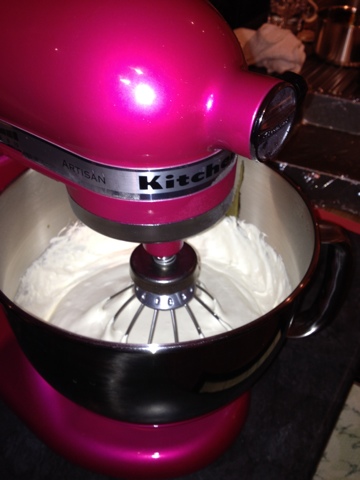
4. Start the stand mixer going at a medium speed and start running syrup down the side of the bowl. If you want terrifying needles of sugar in your mix, let it get on the wire whisk. If not, keep it to the side of the bowl, as below.
Once it's all in, kick the speed up a touch. The mixture will increase in volume and go white.
5. Line the tin with clingfilm and grease the clingfilm incredibly well with your trusty pastry brush. Incredibly well. Literally slathered. This mix will stick to any known substance, even Teflon. Probably not Teflon actually, but you get my point.
6. Pour in to tin and leave to set for 2 hours.
7. When you come to turn it out, coat everything with Cornflour. With a cornfloured hand, hold the marshmallow down and pull the clingfilm from the surface, using you floured hand to ease it away when needed.
8. Cornflour your pizza cutter and chop the mattress of marshmallow into little fairy pillows of sugary lusciousness.
9. Toss them gently in plenty of cornflour, and leave it uncovered overnight to dry out the surface so as they don't stick together.
10. Take to friends and relatives and watch them fall in love!
Subscribe to:
Posts (Atom)