Monday, 16 July 2012

Belazu Balsamic Pearls - tangy jewels of deliciousness

Well, again, it's been a while - you have a trip to Barcelona and a major project at work to thank for that - but my rest has been broken in a pleasingly sharp, mouthwatering manner. Those lovely people at Belazu sent me some of their latest creation to try, namely a jar of their balsamic pearls. Yes, you heard me right - little pearls of balsamic vinegar.

Belazu Balsamic Pearls

Before I get to the pearls, I must first ask whether you have tried their balsamic vinegar? No? Then you have been missing an essential gourmet experience, my friend! I have long been a lover of vinegars to add acetic tang to a meal, right back to when I was a mere lardball-in-waiting at school, when my favourite pack-up would be peanut butter and home-made pickled onion sandwiches on bloomer bread. Before you recoil in horror, try it. You'd be surprised. The sharpness of the vinegar cuts through the cloying peanut butter like a thermic lance through a steel safe. I had a fondness for dipping bread crusts in pickle vinegar, putting beetroot vinegar straight from the jar in my mothers lovingly served stews, and perhaps slightly weirdly, dipping Milky Ways in ketchup. I had a preference for cheap ketchup (which has never quite left) for the tang factor alone.

Belazu Balsamic Vinegar
Needless to say, as I've grown older and educated my palate, my tastes have become more refined. I progressed from harsh malt pickling vinegar to tarragon vinegar, on to sherry vinegar, cabernet vinegar, cider vinegar, black rice vinegar, and of course, the king of vinegars, Balsamic Vinegar, from Modena. I love that balsamic is now such a staple in our cupboards that Waitrose see fit to put it in their 'essentials' range. I've tried many balsamics in my time, but undoubtedly the best vinegar on the shelves today is Belazu Balsamic Vinegar. I have never experienced such a deliciously sweet, unctuous vinegar in my life. If you've tried a balsamic 'glaze' and enjoyed it, you'd be in heaven with this. It has a natural sweetness coupled with a depth of flavour and almost syrupy viscosity that even the best manufactured glaze cannot compare to. It's worth every penny in my book, despite it's higher price tag. Once you've had Belazu, anything else just tastes like a watered-down substitute for a balsamic vinegar. One can see why those chefs with stars are so enamoured of it.

So how exciting, then, that Belazu have taken it upon themselves to take the balsamic journey a step further - by encapsulating this ambrosial fluid into little black pearls of sweetly luscious tang.

Spherification is one of those cheffy things we see on the television programmes that has often seemed a tad out of reach. Something we have to buy a kit for, something a bit gimmicky, something that most hard-pressed, time-starved wage-slaves amongst us are happy to have served up to us in Michelineries, but simply don't have the time to create at home. It also takes a bit of practice to get right, by all accounts. So even if you did fancy a bit of spherifrippery, it's likely to be somewhat hit and miss. Which is part of the genius of Belazu Balsamic Pearls - these little black jewels are visually stunning, taste amazing, but come out of a jar! A JAR! How perfect could it be? (Hint: not much more perfect than that).

Balsamic Pearls - product


The minute I saw these delightful little spheres in knew immediately what I wanted to do with them. I would make a salad of pancetta cubes, fried until crispy and a couple of Burford Browns (care of Clarence Court, natch), which sits atop some toasted ciabatta slices, which has in turn been given a scrub with a garlic clove. This is then topped with some peppery mixed leaves, a chopped, de-seeded red chilli, and some rings of shallot. It is then usually libated with balsamic vinegar. Oil is not needed due to the fried eggs and bacon.

Pancetta, egg and balsamic pearl salad


Now, as delicious as it is, the vinegar does have a tendency to run once devouring commences, but I hoped that the pearls would maintain their integrity a little longer, adding to the visual appeal of the dish. I was not wrong! Given the way they yield to pressure between your teeth and burst with flavour in your mouth, I worried they might collapse upon contact with heat, or salt, or some other suspected slayer of spherification as yet unidentified, but I need not have worried. They are curiously robust. I've included a picture of the half-eaten plate so you can see exactly how well they maintain their shape throughout the plates 'journey' from plate to belly via gob.

Pancetta, egg and balsamic pearl salad - forkfull

I cannot recommend these little blighters strongly enough. They lend themselves to such a variety of applications, you are only limited by your imagination. The next plan is a strawberry cheesecake, studded with these tiny obsidian jewels. If Belazu Balsamic Vinegar verged on perfect, then Belazu Balsamic Pearls are surely a legend in their own lifetime. Try them - you will not be disappointed. 

Warm salad of pancetta and eggs with balsamic pearls
You will note a lack of salt and pepper in this dish - this is deliberate. The pancetta provides enough salt, and any pepper would, in my opinion, detract from the delicate flavour of the vinegar. But if you feel the need, go ahead!


70g pancetta cubes
2 Burford Brown eggs, fried
1 small shallot
1 small mild red chilli, deseeded and chopped
half ciabatta, or 2 slices of ciabatta from a large loaf, toasted
handful or two of fancy leaves 
a clove of garlic
Belazu Balsamic Pearls
1 tbsp olive oil
6 tbsp vegetable oil

Method:
1) Fry pancetta cubes until crispy. Drain in some kitchen paper to remove excess oil.
2) Toast the ciabatta until some of the edges have caught.
3) Take a clove of garlic and rub the surface of the ciabatta.
4) Place the leaves over the ciabatta
5) Heat the vegetable oil in a frying pan and cook the eggs until the white has set, but the yolks are still runny.
6) Place the cooked eggs, drained of excess oil, on top of the leaves, and scatter over the pancetta, chilli and shallot rings.
7) Scatter over the balsamic pearls
8) Devour, greedily.

Saturday, 28 April 2012

Maple Monkey Bread

So it's been a while since I last posted - life has a habit of getting in the way of my virtual musings, however today is one of those bleak British April days when you wonder whether spring has been decommissioned and we are going to skip straight from winter to summer.

There is nothing to do - or rather nothing one feels inclined to do - except watch old films and carb-load. The morning drifts aimlessly into the afternoon, which meanders without purpose into the evening, via copious quantities of tea. Outside, it is dark, dank and one could be forgiven for thinking we have gone back in time to January. In fact, I think this year, January may have been warmer. 

It seems almost inconceivable that not four weeks ago a hosepipe ban came into force, the smell of barbecues hung in the air and I spent entire saturdays pottering in the garden with the spring sunlight glinting on my vampirically pale, sun-starved skin. 

I do remember one distinctly dull day in January when the only thing that was able to radiate some warmth into the house was a burnished and bronzed ring of Monkey Bread baking in the oven. The recipe I used actually makes the bread with proper yeast, flour, butter and for a rich, sweet, bosky resin note, a slurp of Maple Syrup. Many recipes you will find merely advise you to open the can of brioche dough/biscuit dough/bread dough. I have never tried using this method because something in me baulks at buying dough when it is so easy to make. But if you want to try the cheat approach, by all means do. 

Recipes with numerous steps and stages of resting and rising lend themselves well to adding structure to days like today. So for those of you who are feeling in need of some inner warmth, purpose and sweet, soul-nourishing sustenance to accompany the tea and movies, try this!

Maple Monkey Bread (adapted from a recipe on The Pink Whisk)

Ingredients:

500g Strong White Flour
1 tsp Cinnamon
1 1/2 tsp Salt
55g Butter, cold, chopped into dice
2 Eggs, beaten
2 tbsp Maple Syrup
15g Dried Yeast (3 tsp)
175ml Milk (approx)

Sugar coating:
150g Caster Sugar
2 tsp Cinnamon

Sauce:
200g Butter
100g Dark Brown Sugar
2 tbsp Maple Syrup


1. Warm the milk in a small saucepan until it is just warm (blood temperature).
2. Mix 2 tbsp of the warmed milk with the yeast and mix to a smoothish paste. Put to one side.
3. Next, prepare the flour - sift together with the salt and cinnamon into a large bowl.
4. Add the butter cubes and rub in to resemble breadcrumbs.
5. Add eggs, Maple Syrup, yeast and milk paste and enough milk to make a dough (depends on absorbancy of your flour so difficult too be precise).
6. Tip dough onto a lightly floured surface and knead for about 8-10 minutes.
7. Place into an oiled bowl, cover and place somewhere warm to double in size, approx 1.5 hrs.

8. Next, you need to tip it out, knead it again lightly, them chop it into nuggets. The easiest way to do this is to roll it into a sausage and chop it into little pillows, about an inch cubed. don't be too precise or make it too even - it adds to the alure!
9. Once you have all your pieces, pop them into the bowl and scatter the sugar and cinnamon coating over it - make sure it is evenly distributed and each little pillow has a sandy sugary coating.

10. Transfer the doughy pillows to a greased kugelhopf ring. You really do need a ring pan for this to get an even distribution of heat to all the pieces. Let the pieces rise one last time for about an hour.
11. About 20 minutes before you are ready to bake the bread, preheat the oven to 200 degrees centigrade (180 fan). Start the sauce by adding 200g butter to 100g dark brown sugar and Maple Syrup. Melt and stir until the sugar has dissolved.
12. The doughballs should now have doubled in size - pour the hot sauce all over them, then stick them in the oven for about 40 minutes (check after 35).


You might need to make a foil 'lid' to pop over the pan about half way through, to stop them catching.
13. Once 40 mins is up, take out from the oven and allow to cool for a few minutes before attempting to turn out - but don't leave it too long or you will have a job getting it out of the tin. 


I found the easiest way to do this was the plate on top, then flip (you will need oven gloves so take care!).
14. Stand back in admiration at the gorgeous, toffee, chewy, chrunchy, dribbly mass that stands before you. 

The best things about this are that the caramelisation varies between setting to a hard toffee, to pooling into delicious slicks of molten lusciousness; and that it is positively bad form to eat this any other way than for each diner to rip off the scented nuggets of sticky heaven.

Friday, 20 January 2012

Review: Kopi - Your Gourmet Monthly Coffee Delivery

Since New Years Day, I had decided to forego my daily diet of 3 large buckets of Starbucks coffee. The new year would see a new, coffee-free me. Not because I have any issues with caffeine - I still knock back 6 cans of diet coke a day like any good office worker. No, this abstinence was because coffee went far too well with whichever sweet treat I was dining finely upon and my waistline was suffering. Toasted bagel as big as your face, slathered in blackcurrant preserves for breakfast. Chocolate Brownie for elevenses. Oaty biscuits for the afternoon lull. All accompanied by COFFEE! You see my point.
Coffee, and it's accompaniments, was making me fat (ter).


I never make New Years Resolutions. I feel that the very nature of them means you are setting yourself up to fail. Thus it was my coffee abstinence was never to be permanent. Had I known it would be broken in such spectacular fashion, however, I would not have mourned my 'final' cup in 2011 with such abject grief. For, little did I know, I was to be sent a curious idea that would bring me, with a suitably caffeine-infused jolt, to my senses.
Let me introduce you to the world of Kopi.


Kopi is kinda like Graze for caffeine fiends, and they had asked me to sample their product. Each month you get sent a 250g pack of ground coffee, and based on your subscription level (which currently ranges from £7 - £9) you can either cancel immediately, after 6 months, or after a year. So far so good.


Along with your coffee, you get a detailed tasting card giving you notes on the varying coffees they send, along with some guidance on brewing and information about it's provenance. Oh, and a few of those lovely caramelised cafe biscuits you get in restaurants in individual packets. You even get a code that allows you to trace your coffee on www.trackyourcoffee.com.


The website also states Kopi pays its social conscience dues to Fairtrade, Soil Association and Rainforest Alliance initiatives, and clarifies its views on Fairtrade - not all of their coffee is, but they state clearly why. Principally, Fairtrade only certifies co-ops which excludes small growers that Kopi could otherwise not use. They still ensure they pay these smaller growers premium prices for a premium product, and crucially, above the Fairtrade minimum.
This months (I reviewed Decembers coffee) selection, an Arabica coffee and roasted on 6th December according to the pack, was Mexican Terruño Nayarita Reserva, described as 'An indulgent Grand Cru of a Mexican coffee' from the West Coast of Mexico. A rare product, only 20 bags of it having been produced.


So far so interesting. But what of the taste?
One of the things, as a food blogger, I feel I owe to a reader is honesty. I only ever blog what I genuinely think. Whilst its nice Kopi have sent me a lovely pack of coffee if it doesn't ring my bell, I shall darn well say so, or else how do you know when I genuinely love something? I cannot abide it when food bloggers only ever tell you that what they produce, try, review etc is amaaaazing. Not everything I make is amazing, simply because I am human, and I read recipes or try products invented by humans, and as such, we can get things wrong, or we can have different views and opinions on what is nice or good. You need to hear the rough to know that the smooth has value.


Fortunately, I have only good things to report in this case, bar one niggle which I will come to. This coffee is really very, VERY good. I spend at least £7 a day on extremely so-so coffee. If this is all it costs to have something of this quality delivered to my desk for a year, well - I'm blown away. As soon as I smelt the aroma wafting nostrilwards, I knew this was going to be good.


A bright, zingy fruitiness with underlying rich toffee, mocha notes. The guidance card said that there was a delicate orangey sweetness and they weren't wrong. The roast is excellent - not an acrid note in there, and it has a rather pleasing tangy backnote in the aftertaste. It fills your mouth almost like liquid chocolate, it's so velvety. It filled my mouth, anyway - I literally gulped it back. This is sublime stuff. I encourage, nay, urge you to sign up immediately, and then sign up your families, and then your friends. If this first pack is anything to go by, I think Kopi is about to become a phenomenon.
Now, I did mention a niggle. And it is probably being pettish, but I have to tell you when I am not digging a vibe, so, here goes. Kopi - take note! This is easily solved!
The pack, as you can see, is filled to the gunnels, which is lovely of them. You can also see, there are some notches to help you rip open your pack, and a handy press'n'seal strip to seal in the flavour. Except, because of the generosity of the pack, you end up having to use a knife or scissors to open it.


And because of the nature of coffee grounds, the press'n'seal strip did not seal. The grounds get into the strip and block it. See what happens in this video (excuse quality - was done on my iPhone).


This is such a shame, because they have quite obviously really tried. However, for me, I think a sticky tab would have been a better solution. Maybe their market research said otherwise, I don't know. But I want to stress this absolutely should not deter you in any way from trying this product. If you are partial to a caffeine blast, then this hits a deep, profound and previously unchartered spot. The whole concept behind this brand is very well thought out. The fact you can trace the coffee, the information on where its grown, the altitude, the grading process, the little graphics, the quality packaging - it all adds to a certain romance and exotic allure. There is even a recipe for spiced mexican coffee! Personally, with a product this refined, I would not want to sully it. But it's a demonstration of how well the company has thought around the whole coffee drinking experience, right down to the little biscuits on the side. But most importantly, the taste is, quite simply, exceptional. Kopi have found my caffeine G-spot and that, my friends, is good enough for me! Go and visit their coffee subscription page immediately!

Website: www.kopi.co.uk
Twitter: @wearekopi

Tuesday, 10 January 2012

Some fruity kitchen garden ideas for the year ahead

Now is the time I usually turn my mind to my garden planning for the year ahead. The autumn/advent hiatus is over, and the land is at its most dormant, waiting to be woken from its slumber by the warm spring rays of sun. How will I reorganise my beds? What can be consigned to the compost heap? And most exciting, what new things might I try this year? One of the delights of home grown veg is that you get to try things that, ordinarily, are not readily available in the supermarkets. Varieties or species that are just not 'commercial'. I'm no gardening expert, but that doesn't mean I can't broaden my horticultural skillset. So, what to try?
Cast your minds back to last April (2011), when what appeared to be a rather elaborate April Fools day trick was much publicised through the internets and old-school press alike. People were not sure whether to believe that there was an actual strawberry that appeared to be in reverse, or back to front, or inside out, or opposite or whatever. The berry in question was a Pineberry. A strawberry that was white, with little red seeds, and taste of pineapple. Yeah right! Yet there also appeared to be an SEO agency that was also called Pineberry – was this a very clever example of viral marketing, or did the things actually exist?

The somewhat cynical web team I work with was wholeheartedly on the side of it being an April Fool. But in a BBC article, it stated that Pineberries were sold by Waitrose. I thought it odd that a hoax would be so specific, and unless Waitrose was in on it, this started to look promising. So I did no more that call Waitrose at their head office in Bracknell. The lovely chap I spoke to thought I was having a laugh, initially, when I enquired about the nearest Waitrose that stocked them. He did not seem overly well-versed in the berry range that Waitrose offered their customers. Thus when I mentioned our suspicions that this was a hoax, he concurred without much persuasion. But what he then did, and this is why I love the John Lewis Partnership, was to go off and check with his manager. Even though he probably thought his manager was about to laugh her head off at him, he bore no malice and martyred himself on the alter of superior customer service. His manager had obviously read her dispatches that day, for she confirmed that this berry was no hoax. It was real. The hallowed berry was a horticultural truth. The lovely chap confirmed that the nearest stores to me that sold it were some distance from me. I think that was their politically correct way of saying ‘we are only selling it in areas where people fall into the 'right' demographic’.
Thus, I had to suffice with knowing that the Pineberry was an actual berry and not the brainchild of an ad agency, without actually managing to get a taste of it.

However all is not lost! For this year, I am pleased to announce you will be able to purchase your very own supply of white fruits with red-seeded pock-marks. Crocus.co.uk will now be stocking Pineberries on their virtual garden-centre shelves! Which means you won’t have to live in exorbitantly priced, stock-broker belt areas in order to purchase them. Now you too can pretend you are one of the Softfruiteratti. All you will need is a sunny spot, some decent soil, a bed of straw, some organic fertilizer and water. Organic fertillizer because, when it comes to things I eat, the act of dousing my home-grown foodstuffs with chemicals renders them psychologically inedible for fear of the carcinogens that lay within (said the ex-40-a-day-smoker). Even though I don't buy wholly organic at the supermarket. Go figure.
I read the following review in The Guardian which was less than complimentary about these curious fruits, however this has not disuaded me. There are those for whom the aesthetics will be persuasion enough to buy them, and those, like me, who enjoy the novelty factor. I am not persuaded by a one punnet experiment either. I have been waiting a long time to try the little blighters, and will be putting in an order for them immediately!
There are other varieties of white strawberry available, with excellent flavour, and you can purchase seeds for the White Soul variety from Suttons. These have no red on them at all. Right now, it's just about the right time to sew them under glass.

Here are a couple of other ideas for your garden that aren’t quite so run-of-the-mill:

Medlars


From the dimiutive strawberry to the enormous tree. These have started to re-appear in the food-blogs & telly progs over the last year or so. I remember seeing them discussed on QI some time ago, and I do wonder whether this mention got people pondering upon them. The nerd in me wants to look at broadcast dates of the show in question and check medlar sales in comparison, but that would be phenomenally sad. There is something rather pornographic about these fruits, indeed their nickname during the middle ages was ‘open-arses’. If you take a look at the photo you will understand why that name is rather apt. Medlars require ‘bletting’ before they are edible – you will read in varying sources that this means you have to leave them until they are rotten before they can be enjoyed, but I am here to reassure you this is not quite the case. They do not rot in the true sense of the word, i.e. decay - there is no bacterial activity. It’s just their ripening process is rather lengthy and extreme and indeed you could be forgiven for thinking it had gone bad. The texture is a somewhat grainy, reminiscent of pear, applesauce and the taste is like appley booze or boozy sweet apples. Acquired, but worth acquiring.

Mulberries


A fruit immortalised in the famous nursery rhyme, this is a plant that again seems to have fallen from edible favour, possibly since they do not store or travel well. Perhaps it’s because of their association with silkworms that children find them off-putting, I don’t know. However these are also tasty little fruits and come in a variety of colours, from white to deep red and black. The white mulberry (the silkwormy one, native to China and available from Reads ) has white fruits which turn pinkish, so not white in the strictest sense. Happily, no doubt due to our renewed interest in heritage fruits and foraging, Crocus.co.uk is also selling the common black mulberry too. Be warned, though - it will need space and a suitable site. This is a full-sized, albeit magnificent, tree.

Now, if you happen to find yourself with white strawberries and white pineberries, I am envisaging a rather minimalist white pavlova, swathed in snowy, softly billowing whipped cream and scattered with your collection of white fruits, and a frosted bunch of whitecurrants adorning it, with a scattering of glitter for that sparkly touch of the camp. You could guarantee nobody else would be serving it on your dinner party circuit. And that's the joy of growing your own!

Small batch baking: Cherry crumble

Ok, so not strictly baking in the sense of a cake but it satisfied my need to smell butter, sugar and flour caramelising in the oven!
As I have previously bemoaned before on my humble bloglette, baking for one or two, indeed cooking in general for one or two, can be bothersome. Regardless of how expensive it can be to cook large batches that either get wasted or given away, there is also the irritating recipe reduction part. What I mean by this is the time spent prior to actual baking putting my (lamentable) maths skills to good use (or rather my iPhone calculator to good use), and infrequently realising that this recipe is now so diminutive it cannot be mixed in my beloved Kitchenaid. Instead it requires me to break out into a sweat whilst I process my ingredients manually. The ignominy! So it's rather pleasing when one happens upon a recipe quite by chance, and in the habit of all great inventions, it was borne of necessity.

This recipe came about after I had a self-generated glut of cherries in the fridge. I'm a sucker for a plump, shiny, tight-skinned red fruit, and these cherries were looking all appealing and winsome at me in the supermarket. It was physically impossible not to pop them in my basket. However, with a plethora of apples, tangerines, grapes, mangoes and the like already cascading out of my fridge, after a few days I decided these would possibly require cooking into a compote for storage in the freezer until a later date or else they would not get eaten.
I promptly popped all 250g into a pan, along with a tablespoon of caster sugar, a tablespoon of cherry jam (my favourite), a tablespoon of water and a healthy splosh of Chambord (although I was torn between this and my trusty bottle of supercassis).
I warmed it through, dissolving the sugar, and made sure it didn't boil.
Oh good heavens, it was marvellous. As soon as I tasted the ambrosial juices I knew this would never see the inside of the food no-mansland that is my freezer. This was going straight in my tummy, possibly via a scoop of vanilla ice cream. I mean, there wasn't enough for a pie. Or a cheesecake. I couldn't think of anything more imaginative than hot cherries over a blob of Green & Blacks Vanilla.
And then I had the brainwave!
I quickly dug out a couple of mini Pyrex casserole dishes (glorified ramekins) I'd never had use for, and divided the contents of the saucepan between the two. I then grabbed a mixing bowl, and emptied the contents of a sachet of Dorset cereals porridge oats into it, along with 2 dessertspoons of brown sugar, two dessertspoons of plain flour and two dessertspoons of butter. I threw in a half teaspoon of cinnamon, and started rubbing in.

The flour was fairly absorbent so took another couple of teaspoons of butter before I was happy. I didn't want a crumble in the true sense of the word - I wanted something rather more nubbly. So I wet my fingers with some cold water, and started to squeeze the crumble into little rough clumps of flapjackyness. I then scattered my broken sandstone lumpoids over the two casseroles of Cherry compote. Dinner was already in a 170 degree fan oven, so that's what my crumbles went in at. For about 15 - 20 minutes.

Art is not always about straight lines, perfect angles and intent. Sometimes the artist gets the best out of the materials by just watching what happens. By the happy accidents.  
The cherry compote had a lot of liquid. Some would say too much. And the rubbley flapjack crumble left little holes the juice seeped through. But shown the heat of the oven, this seepage turned to glorious toffiness, forming a sticky shell around the knots of oaty crumble. The fruit was deliciously tart against the warmly spiced, sandy, biscuity topping. This was pudding art.


A little scoop of cold vanilla ice cream melted gently into the sauce creating a magenta, cherry-scented custard. It was everything I had hoped it would be. I'd have been happy to consume the other pot the following day, but the teenager devoured it with unashamed gusto, declaring it fabulousness in a dish. I think she might just be right.

One of the joys of small batch baking is the happy fact that you can afford to be a little luxurious. A standard crumble made with just cherries is ludicrously expensive unless you are lucky enough to have a tree. But a crumble made for two allows a little more decadence, and satisfies the small batch baker all at the same time! Huzzah!


Friday, 25 November 2011

Jell-O what?

The other day, my colleague left for his annual Thanksgiving break, and this time was flying home to Texas and then on to Delaware with the family. Whilst I am very happy he had such a lovely trip ahead, I am also a tad miffed, for I look forward to the leftovers and 'Tales from the Thanksgiving Table’. Last year was the first time I had tried Candied Yams, complete with marshmallows, and this year I was looking forward to yet stranger offerings, for he had told me of apocryphal traditional dishes such as green bean casserole, and I wanted to try them. (The recipe and picture below, for Candied yams, from Recipekey.com, is very similar to the recipe I made).


One of the things I love about our autumnal festivities is that, by and large, they are more to do with giving thanks and nature’s bounty than they are materialism. They hark back to a time before religion as we know it, to an entrenched, paganistic need to thank the land for what it’s given us. Sure, the shops fill with all manner of the brightly coloured, orange, black, green and purple, with the odd ghostly white thrown in for good measure – and they convince us that Halloween is about buckets to collect sweets in, and pumpkin candles and the like. That’s true to a degree, but the best parties are always the ones where the witches and skeleton costumes are home-made out of old tights and bin bags, and the food is made with creativity and a well-developed sense of the macabre. It’s too easy to buy it all, and I think that the desire to craft our own Halloween is deep within us – it’s about physically exorcising the bad through our own creativity. It’s about taking what we have and making the best of it, about thanking the earth, and celebrating the bounty of nature. The day I see ready-carved pumpkins in the shops will be the day I know that commercialism has started to win, but whilst people are still slicing awkward triangles for eyes, there is hope.

Thanksgiving is typical of an autumnal feast day. Again, the shops start with the fancy tableware and napkins, but it is still mainly about people you love gathering together over food and giving thanks. Although it’s principally an American tradition, as is the way with Americana, it is seeping into the British psyche. And as is the way with the British psyche, we have a tendency to assimilate the best of cultures that come to our shores. We have been doing it since the Roman times, and probably before that. If there’s a knees-up to be had, we will go and pray for a few weeks in the new-fangled temple prior to the big day if it means we get invited to the party. Why should Thanksgiving be any different? More and more people I personally know are having thanksgiving meals. At a time when churches are emptying out quicker than a JD Sports during a riot, we seem to be tail-gating the tradition as a kind of proxy-harvest festival. And so it is that all is not lost, for another friend who cooks Thanksgiving every year for a variety of ex-pat Americans plugged the festive gap for me in a rather surprising way.

Whilst in a frenzy of activity at my desk the other day (ahem), she sidled up to me and asked ‘Jen, what's the UK equivalent of Coolwhip?’. I immediately assumed the now defunct frozen Superwhip would be our closest equivalent, or Birds Dream Topping (now there's a misnomer if ever there was one), and then I wondered why on earth she wanted a substitute for a cream substitute? Was that not just cream? I tried in as diplomatic a way as possible to ask the question without sounding like I was calling her an idiot (for she is not, she is a highly intelligent young lady, which only served to further confuse me) and as she explained, all became clear. The delightful dish she was to be creating with her Coolwhip? Jell-O Salad.


Any Americans amongst my readers (oh how I flatter myself I am read globally) will instantly know what Jell-O Salad is. However to the uneducated Brit, it is alien. In the UK, we have been led to believe that thanksgiving dinner is just like Christmas dinner – roast turkey and all the trimmings. It is true, it is a feast dish, and is based around the native American turkey, roasted and dressed, with a variety of vegetable dishes served alongside. That, broadly speaking, would describe thanksgiving dinner. But in reality, the meal can be very different.

Let’s start with the turkey. Even cooking methods are different in some cases, though still by and large roasted. More and more, these days, according to a recent survey I saw, the most popular method, in fact, is to barbecue them outside. Traditionally, in the UK, we stuff the neck and the cavity with sage and onion, or if you are my mother, apricot and almond sausagement in the bird, with sage, onion and chestnut stuffing balls done separately (in America separate stuffing cooked outside the bird is 'dressing'). We dress and decorate the bird in a variety of garbs and unguents, principally streaky bacon but for those with rather more developed tastebuds and purses, pancetta, and anoint the skin with butter, push butter under the skin, indeed inject butter into the flesh to prevent that traditional turkey travesty, the over-cooked breast - basically as much butter as possible will counteract the long, dehydrating bake in the oven. In recent years we have taken to brining as a way of encouraging moistness. The Americans, however, take yet another tack. Some people like to deep fry their birds (yup), even having specialised fryers for the very purpose, and they would more than likely serve their cornbread ‘dressing’ separately, having reconstituted it in a pan first on the stove-top.

Then we come on to the real crazy stuff – the accompaniments.
The one perhaps the brits are most familiar with, thanks to the wonderful Nigella, is the aforementioned Candied Yams topped with marshmallows. I know – I hear a nation dry-heave. But this is, for the carb-addicted, sweet-toothed amongst you, simply fabulous. The sweetness of the potatoes with the spice from the cinnamon and the crispy, caramel vanilla of the marshmallow is just like velvet duvets of unctuousness on the tongue that complements the briny turkey beautifully. I know this for a fact as this was the first thing I ever tried in ‘Tales from the Thanksgiving Table’, and I have since made it myself several times. This one gets a tick.
The next is the apocryphal green bean casserole. Now – what do you think of when you hear the word casserole? A base of onions, celery and carrot, fried off, a touch of garlic and then some decent stock added to a mix of flavourful veg and meat, a splash of wine, all waiting to be cooked long and slow?
That is everything green bean casserole is not.
Green Bean Casserole is a mixture of canned or frozen green beans (obviously), Campbell’s cream of mushroom soup, and crispy fried onions (from a packet). Note I name the brand of soup – that is because Green Bean Casserole was invented in 1955 by Dorcas Reilly, Campbell's head chef, on behalf of Campbell’s soup, utilising specifically only store cupboard ingredients.
The next accompaniment was what totally bemused me. The first time my friend told me of it, I thought she had had a Rachel moment – you know? The one where the cookery book gets stuck together and she makes shepherds pie trifle? This is the recipe which started my brief foray into this American Thanksgiving dinner piece: The Jell-O Salad.
Imagine, if you will, a concoction of lime Jell-O (Jell-O in America is, I am led to believe, the powdered variety), that is then mixed with Coolwhip, and cottage cheese.
And then served with the turkey!
When my friend told me that her American friends mother had given her the recipe (where, if you couldn’t get it, the lime Jell-O could be substituted with strawberry) and then served alongside your beautifully burnished and bronzed roasted bird, I simply didn’t believe it. It was a little like the first time I learnt of the nuts and bolts of having sex. I was about 8 years old, and my friends older sister had given us the cold hard facts about what went where. I simply did not believe it. This was in the days before Google, I hasten to add – now, I would be given pictorial evidence in nanoseconds.
Thus it was with Jell-O salad. Too outlandish to even dream that this was a real recipe. The recipe that I found most outlandish was one that combined cucumber, onion, horseradish, and pineapple with cottage cheese and strawberry Jell-O. I know our American cousins have a sweet tooth, but really? (See below picture from ourfamilyrecipes.blogspot.com for an example of the mystifying concoction - I think I prefer the idea of vanilla pudding in it)


I got to wondering whether this was something that was perhaps viewed in the same way we view sprouts or Christmas pud – a tradition to be endured? The real issue with sprouts and Christmas pud, however, is not that they are inherently vile – it’s that they are cooked badly, by and large. Christmas pudding, I have discovered in recent years, is actually sublime when gently steamed after months of maturing. It's not great, however, microwaved to oblivion. Sprouts boiled until grey are, and never were, representative of cruciferous greatness. Therefore could this Jell-O salad perhaps fall into the same ranks of ‘we make it that way because, well, we just do’?
A straw poll amongst those I know from the North American continent confirmed otherwise. They make it because they like it. Pure and simple. They cannot hang a nations shame on the ‘tradition’ peg. Or so they say.
Although these dishes don’t really hark back to the time of the pilgrim fathers (unless jet-puffed marshmallow and condensed cream of mushroom soup was prevalent in Plymouth), they still tell a story of Americana, but more a modern, industrial history, where the housewife started working and time was tight. Where we had learnt new ways to mass produce and store food. The thing that my friend found most alarming was that her American guests, upon finding her one year in a sweaty, exhausted, red-cheeked heap upon arrival, howled with sympathetic laughter at the effort that she had gone to. The pumpkin pie was home-made, the flesh cooked and pulped, pie crust blind baked; the cornbread stuffing was made with actual cornbread that had been baked for the sole purpose of the stuffing. The cranberry sauce had been made from scratch. The Americans found this hilarious, but also inauthentic. They gave her the name of a lovely little American shop near Bagshot where she could purchase Keebler pie crust, Libby’s canned Pumpkin, genuine Jell-O, Frenchs Fried Onions and Aunt Jemima’s cornbread stuffing mix, amongst a variety of other pre-packaged, dessicated and dehydrated thanksgiving staples to be reconstituted at a (much) later date. This year, everything came out of a packet. Hell, this year, they even sold the stuff on Ocado! And do you know what? Her guests all said that, this year, it was just like momma used to make. Do you know why? Because it was.


The real thanksgiving story is a mix of harvest rituals, historical pride and religious traditions – Native American, British, Dutch, Canadian and other nations. It is perhaps still being crafted. We live in an age of plenty in the western world, thanks to the greatest industrialised nation on the planet, one that has formulated a way to ensure that food is plentiful for its population, even if not always exactly fresh. What the blogosphere demonstrates is that there are plenty of Americans out there blazing a trail for the home-cooked, the locally produced and the non-hydrogenated/dehydrated/powdered/instant, just as there are in Britain. But let us not sneer at what has become traditional, for if the Brits were to look to their own larders and recipe books, we have our fair share of oddities. Who am I to cast aspersions when I live in a country that regards Bisto as the smell of childhood, and where stock is Oxo and stuffing is Paxo for a great majority? Let us not sneer either at what those few people, who landed on the shores of Massachusetts in 1621, have achieved and have given the world. People throng to shout the American nation down, particularly in the UK. It is easy to do, and it’s the acceptable face of racism and xenophobia, but it shouldn’t be. Every nation has it's dark side. But every nation has something to be proud of too, and that’s what giving thanks is about. Without America, the world would be a much poorer place culturally and gastronomically if nothing else, and if we want to get pedantic about it, it’s all down to a few Europeans anyway! So I for one raised a metaphorical glass of egg-nog (Borden, natch) on Thursday to the great nation, and gave thanks to Aunt Jemima, Libby’s, Campbell’s and Keebler for their unique role in a nations gastronomic history.
But maybe not to Jell-O.


Tuesday, 22 November 2011

Passionfruit bars

My name is Jennifer and I have a passionfruit addiction.

Rich in beta-carotene, vitamin C, lycopene, potassium and with many other healthful properties, there are worse things in life to be addicted to, which as an ex-nicotine fiend I can attest to, so I like to indulge this particular addiction as frequently as possible. The passionfruit bars I am about to share with you came about after I purchased what can only be described as the find of the century, for someone who loves passionfruit as much as I do.


The problem with passionfruit in this country is that, by and large, they appear in the supermarkets all smooth-skinned loveliness, shiny, purple-green. But though they may look delightful, at this stage they are unripe and a bit pony, to be frank. What I want to see is, in fact, massively overgrown peppercorns – wrinkled, puckered, a bit ‘past their best’ looking, as this is when they actually taste of something. Alas, I rarely find them looking like this. Even when I buy them and stick a banana in with them to ripen them earlier, they just don’t seem to have much resonance flavour-wise. How on earth do cheffy types manage to procure passionfruit that taste of something a little more dynamic than watered-down Um Bongo? And I mean plain, pure passionfruit, by the way, I don’t want it adulterated with orange juice or mango. Just naked, glorious passionfruit.


After much trial and error with smooth and wrinkly ones, purple and golden ones, and a lot of googling, I made a discovery that has transformed my kitchen. It is now, regularly, heady with the scent of the tropics (or so I imagine having never even been to ‘the tropics’. I probably flew over them on the way to Tasmania once, but that was as close as I got). Merchant Gourmet, they of the deliciously chewy, sweet, raisin-like mi-cuit tomatoes, ready-to-zap puy lentils and other gourmet delights, have a ‘chef’ section on their site. Contained within said ‘chef’ section is bottled passionfruit juice. Eeep!


Well, strictly speaking it's a puree, not a juice, but its rather more fluid than a puree, to my mind. No matter, it does not detract!

Now, when I first saw this, I was hesitant. We are a bit tight-lipped about pre-bottled gubbins, aren’t we? Unless either we have bottled it ourselves, Aunty Mabel has bottled it, or it was bought from a farmers market of high repute, we tend to be suspicious of things that are pre-packaged. Not for the first time have I erupted with tangible, almost ectoplasmic joy at finding an elusive product, only to be deeply disappointed at what was contained therein, having left a slop of misplaced joy-slime in my wake. However on this occasion I was more than pleasantly surprised. I was goddam ecstatic. For whether this was pre-bottled juice or not, it was really excellent. The Bon Maman of bottled juice, if you like.No - the Merchant Gourmet of bottled juice!

Not only do I love passionfruit, but I hate the seeds with probably equal fervour. I hate any kind of frog-spawniness in fruit and veg. It is just wrong. I always disgorge cucumbers, deseed tomatoes, and look upon with envy those who pop whole cherry tomatoes in their mouths with gay abandon. I cannot think of anything more repulsive than popping the shiny, tight skins and happening upon gelatinous seed pulp. I feel a gip forming in my throat as I describe it. Which is fairly problematic when it comes to passionfruit as that is, ostensibly, what they are – pulp and seed. But, oh, the fragrance! Oh, the puckeringly sharp, teeth-dissolvingly acidic golden juices that encase those evil little black seeds!

Thus my excitement at the Merchant Gourmet product was yet all the more heightened as there was not a nasty little blighter of a seed in sight. Why do chefs and manufacturers insist in putting the seeds in things? I was told once that it is to show it’s real juice that’s used, not flavouring, but to be honest, if a fake flavouring was that good you couldn’t tell, that would be fine. Anyone worth their salt knows fake flavouring from real passionfruit. So I say, banish the ruddy seeds for good and sieve the damned stuff. And so, apparently, do Merchant Gourmet.

I purchased a bottle of the juice, £5.99 for 1kg (90% passionfruit juice, 10% sugar one presumes for the preserving properties, and still so fresh-tasting and sweetly sour that it makes every gland in your mouth cascade like Niagara). It’s a great product, and when used in marshmallows (see previous post), mousses, ice creams, sorbets, glazes, jellies and in the following recipe, I defy you to tell that it’s bottled. But if you are particularly precious, by all means use fresh passionfruit. Or if you are worried that the guests might think you are faking it, buy a passionfruit and scoop it, seeds and all, into your mix, along with some of the bottled stuff – the flavour is superbly deep and intoxicating. Talking of intoxication, the application of it in cocktails is limited only by your imagination. Passionfruit Bellini’s? Yes please!

This is a recipe adapted from the Hummingbird Bakery cookbook, and is so delicious, I have to ration it when I make it. Their fabulous recipe for lemon bars lends itself to all sorts of jiggery-pokery – I’ve made St Clements versions, lime versions, grapefruit, even blackcurrant – if its sharp and acidic, it works. It's quick, it’s easy and it's super-impressive. I have been known to serve it with cream as dessert. A delicious shortbread base, topped with a lemon, or in this case passionfruit, curd.

Make this at your peril. It’s habit-formingly good!


Ingredients:

• 200g caster sugar
• 3 eggs (please use good ones)
• 100ml of Merchant Gourmet Passionfruit juice

Ingredients for base:

• 140g plain flour
• 120g unsalted butter
• 35g icing sugar
• 2 teaspoons of grated lemon zest
• a pinch of salt

Method:

1. Preheat the oven to 170 degrees C.

2. Grease baking tray & line it with parchment paper.

3. The first stage is to make the base. Put the flour, sugar, salt, butter and lemon zest and using a hand held whisk, or a stand mixer, beat until the mixture resembles breadcrumbs. Or, if you are feeling particularly domesticated or don’t want too much washing up, it really is as easy to use your hands to make a lovely sandy crumble!
4.Press the crumble into the base of the prepared baking tray, flattening the crumbs down to make a pastry base. Bake in the preheated oven for about 20 minutes, or until light golden brown.


5. Put the sugar, eggs, passionfruit juice and zest in a bowl and whisk until well-mixed. It doesn’t say to do so, but I always seive the eggs to avoid nasty white clods in the final curd mix.


6. Pour over the baked base and return to the oven. The size of your tin will determine the depth of the tray-bake. Bake for 20 minutes or until the edges are golden brown and the topping has set in.


7. Leave to cool completely and either dust with icing sugar before serving, or drizzle with a criss-cross of dark chocolate, or straight up with no embellishments and let the glorious egg yolk orange sing out. Serve in bars as a tray-bake, or with a dollop of cream as a delicious, well-behaved alternative to a Tarte au Citron.


With a delicious slurp of cream for dessert!


Mummicat certainly approved!


Monday, 14 November 2011

Adventures in shmallow

Some time ago, I read an article in Delicious Magazine about how to make marshmallows a la Bea's of Bloomsbury, using fruit smoothie, and sans egg.

I don't know why, it had never occurred to me before that it was possible to make marshmallows on a domestic scale. It may seem obvious to some, but to me, the distinct absence of a domestic jet puff facility in my teeny tiny kitchen would immediately render the pursuit of home-grown marshmallow futile.

Seemingly, I am labouring under an uneducated misapprehension. You can, in fact, create marshmallow in your very own kitchen, with the aid of a stand mixer (thank you once again, Kitchenaid), gelatine (thank you dead animal bones), a shedload of sugar and a glug of golden syrup (thank you, Tate & Lyle).

Now - one thing you have to understand is that without the aid of the industrial jet puff machine, these are not the 'cumulonimbus' of the sweet world. But they aren't bad either. Rather, they are more... well, in all honesty, having made my very first batch, the nearest thing I can liken it to is...well...delicately fruit-scented neoprene. But don't get me wrong! It's tasty neoprene!

I jest. No, in all seriousness it's actually very, very good. It's more like tempur mattress. KIDDING!


It's not at all chemically, unlike the little clouds of sugary, squidgy air you buy in bulk from the pound shop, and is rather less uniform - it has a light, fruity freshness that you just will not get from a commercial brand. I may, however, be being rather facetious of my efforts in my latex-based description, as the following demonstrates.

I took some into the troops today, and was rather thrilled to watch a look of vague disgust turn to joyous disbelief that flooded their faces on trying a piece.
The first thing they said was 'Wow!'.
The second thing they said was 'Did you make that? That's amazing!'.
The third thing they said was 'I didn't think it was possible to make at home! What's the recipe?'.

So, for fellow Marketing buddies and marshmallow connoisseurs, here it is:

120ml fruit juice/smoothie (in this case passionfruit)
2 sachets of Dr Oetker powdered gelatine (approx 30g)
440g caster sugar
160g golden syrup/corn syrup
Vegetable oil to grease tin
Cornflour for coating

Utensils: suitable tin approx 20cm x 20cm, clingfilm, brush, pizza cutter, sugar thermometer, saucepan.

1. Place juice in bowl of stand mixer. Sprinkle gelatine over. Leave to sponge.
2. Boil sugar and syrup together til it reaches between 130 and 140 Celsius. Be careful not to scorch it, and although it takes a while to get there, when it goes, it goes quick!
3. Remove from heat and allow to cool for a minute.
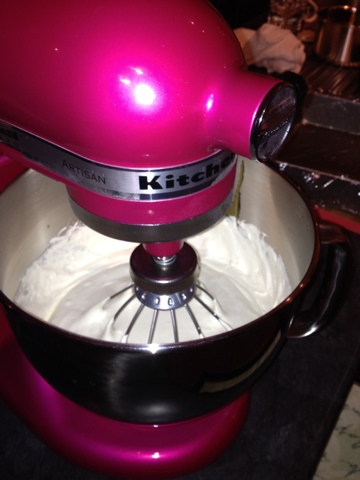
4. Start the stand mixer going at a medium speed and start running syrup down the side of the bowl. If you want terrifying needles of sugar in your mix, let it get on the wire whisk. If not, keep it to the side of the bowl, as below.
 
Once it's all in, kick the speed up a touch. The mixture will increase in volume and go white.
5. Line the tin with clingfilm and grease the clingfilm incredibly well with your trusty pastry brush. Incredibly well. Literally slathered. This mix will stick to any known substance, even Teflon. Probably not Teflon actually, but you get my point.
6. Pour in to tin and leave to set for 2 hours.
7. When you come to turn it out, coat everything with Cornflour. With a cornfloured hand, hold the marshmallow down and pull the clingfilm from the surface, using you floured hand to ease it away when needed.
8. Cornflour your pizza cutter and chop the mattress of marshmallow into little fairy pillows of sugary lusciousness.
9. Toss them gently in plenty of cornflour, and leave it uncovered overnight to dry out the surface so as they don't stick together.
10. Take to friends and relatives and watch them fall in love!